
SITE GUIDE
SEARCH
REVIEWS
FEATURES
NEWS
Etcetera and
Short Term Listings
LISTINGS
Broadway
Off-Broadway
NYC Restaurants
BOOKS and CDs
OTHER PLACES
Berkshires
London
California
DC
Philadelphia
Elsewhere
QUOTES
On TKTS
PLAYWRIGHTS' ALBUMS
LETTERS TO EDITOR
FILM
LINKS
MISCELLANEOUS
Free Updates
Masthead
Writing for Us
A CurtainUp Review
School for Wives
|
Marriage, Agnes, is no joke. The position of a wife calls for strict duties; I do not mean to exalt you to that condition, in order that you may be free and take your ease. Your sex is formed for dependence. Omnipotence goes with the beard.
—Arnolphe
|
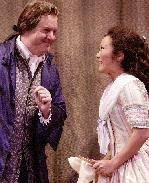
DanDaily and Hannah Moore in School for Wives
|
In a lot of ways School is a comedy of manners, and despite a few moments of well-choreographed slapstick director Shepard Sobel clearly wants the audience to focus on the dialogue. Consisting of two benches and one wall with two doors and a small curtain, Harry Feiner’s set draws little attention to itself, while Frank Champa’s period costumes are (while appropriate) not overly memorable. The play gets its satiric bite from the performers, and as usual the Pearl’s highly competent professionals are generally equal to the task. Dominic Cuskern is a worthy Chrysalde (Arnolphe’s friend and probably Moliere’s direct mouthpiece), and Noel Velez and T.J. Edwards put in solid performances as the young interloper Horace and his father Oronte respectively (Edwards is also memorable in a brief appearance as the stooped and shuffling Notary). Bradford Cover and Rachel Botchan, meanwhile, are surprisingly good as the idiotic servants Alain and Georgette, whose comic scenes have the most energy in the entire production.
The central focus, of course, is on Arnolphe, played by Pearl veteran Dan Daily, and his ward and potential bride Agnes, played by Hana Moon. Moon is particularly good at making Agnes simple but not stupid, and her delivery of Agnes’s painfully honest (if innocent) declarations of her feelings for Horace and corresponding lack of them for Arnolphe is spot-on throughout. Daily, for his part, is at his best when confronted with (for Arnolphe) horrifying news—as the play proceeds and his hold on Agnes appears to be slipping despite his best efforts, his combination of bluster and bemused expressions of disbelief are particularly funny and well-considered. And his delivery of Arnolphe’s almost stupefying sexist credo is entirely convincing. By the play’s end the audience has come to dislike him so much that it roots thoroughly for his comeuppance. The problem, though, is that we aren't supposed to dislike him quite that much. The fact that we do suggests a weakness at the heart of this productionl.
For all of its undeniable competence there is a kind of mechanical feel to the performance, and in some cases it’s hard to see the subtlety at the heart of Moliere’s vision. In a production I saw years ago Arnolphe was shown to be both maddeningly sexist and wistfully pathetic, both irritating and pitiable at the same time. Here he is played as such an irredeemable blowhard and buffoon that we just don’t care much about him, and as a result we miss the sad undercurrent of the play evident in its best productions. Whether this is a result of too one-dimensional a direction, unsubtle acting or an inadequate translation (this version’s, done by Earle Edgerton, is far inferior to Richard Wilbur’s more famous one), the result is a funny but somewhat shallow rendition of Moliere’s classic. Playgoers will leave the Pearl’s take on The School for Wives laughing, but whether they’ll think about its more serious implications afterwards—as Moliere would have wished—is not nearly as certain.
|
THE SCHOOL FOR WIVES Playwright: Jean-Baptiste Moliere Translated by Earle Edgerton Director: Shepard Sobel Cast: Rachel Botchan (Georgette), Bradford Cover (Alain), Dominic Cuskern (Chrysalde), Dan Daily (Arnolphe), T.J. Edwards (Notary, Oronte), Hana Moon (Agnes), Noel Velez (Horace) Technical Director: Gary Levinson Scenic Design: Harry Feiner Costume Design: Frank Champa Lighting Design: Stephen Petrilli Sound Design: Sara Bader Running time: 2 hours including fifteen minute intermission The Pearl Theatre Company, 80 St. Mark’s Place, (212) 598-9802 Web Site: www.pearltheatre.org From 11/10/06 through 12/24/06 in rotating repertory; opening 11/19/06 Tues. @ 7 p.m., Wed. @ 2 p.m., Thurs. and Fri. @ 8 p.m., Sat. @ 2 and 8 p.m., Sun. @ 2 p.m. Tickets: $40 for all performances except Friday, Saturday @ 8 p.m. and Sunday ($50) Reviewed by Gregory Wilson based on November 17th press performance |
Easy-on-the budget super gift for yourself and your musical loving friends. Tons of gorgeous pictures.

Leonard Maltin's 2007 Movie Guide
At This Theater
Leonard Maltin's 2005 Movie Guide

 >
>