
SITE GUIDE
SEARCH
REVIEWS
REVIEW ARCHIVES
ADVERTISING AT CURTAINUP
FEATURES
NEWS
Etcetera and
Short Term Listings
LISTINGS
Broadway
Off-Broadway
NYC Restaurants
BOOKS and CDs
OTHER PLACES
Berkshires
London
California
New Jersey
DC
Connecticut
Philadelphia
Elsewhere
QUOTES
TKTS
PLAYWRIGHTS' ALBUMS
LETTERS TO EDITOR
FILM
LINKS
MISCELLANEOUS
Free Updates
Masthead
A CurtainUp Review
The Orphans' Home Cycle
|
The Orphans' Home Cycle Part One at the Signature Theater
By Elyse Sommer
Foote left this mortal coil last year and can no longer be seen sitting in the rear of a theater presenting one of his plays. Now that I've seen the first part of Foote's artful collage of nine of his sixty plays (plus award winning screen plays and a memoir) I heartily concur Lauren Yarger's rave review when she saw the Cycle at Hartford Stage. The Orphans Trilogy, an assemblage of nine of those plays that were written between 1974 and 1997 is a wonderful capstone of Foote's legacy. I'll therefor just add a few comments to her review which is posted below the production notes. Though the Signature Theater is smaller than the Connecticut venue, Michael Wilson's artful staging has transitioned extremely well. The stagecraft is as awesomely wonderful as Lauren found it to be. And for a long-time Foote watcher, seeing these plays is like a visit to what's become an instantly recognizeable literary landscape with characters — some met before, some neighbors and relations of previously encountered residents of the Southeast Texas area in which Foote's plays are set. Having Foote interpreters like his daughter Hallie and Pamela Payton-Wright on board adds to this sense of stepping into the pages of a well-thumbed and treasured theatrical scrapbook. I was particularly struck by the way these first three plays were connected not just by the central story of Horace Robedaux's search for his place in a world that is not particularly kind to him, and the way actors fluidly step in and out of roles. Fluidity is, in fact, a word that seems as if it's been invented for the direction and stage craft of this ambitious project. While Foote's plays have often been called Checkhovian, Convicts, the middle play of this first part has a distinctly grotesque Dickensian feel, with young Horace only slightly better off than the convicts whos labors keep a Civil War veteran Soll Gautier's (James Demares) run down plantation afloat and Hallie Foote's Miss Haversham-like Asa Vaughn (a fabulous metamorphoses from Horace Robedaux's paternal grandmother). For Signature Theater regulars, Lily Dale, the concluding play, will bring to mind the setting and melancholy sadness of The Trip to Bountiful produced during the company's 2005 Horton Foote season . Besides the use of Jeff Cowie's moving panels to shift the setting to a variety of interior and exterior locales, the way they graphically set the scene for the drama about to unfold also establishes the fact that the three parts of the Cycle can indeed lay claim to being the event of the season —, think of Tom Stoppard's Coast of Utopia two years ago (review, Alan Ayckbourn's Norman Conquests (review) last season, and just a few weeks ago, Tarell Alvin McCraney's Brother Sister Plays (review). While, all these theatrical patchworks were free-standing, theater enthusiasts rushed to see them all, and all-day marathon viewings were particularly popular. The impact of the stunning openings for each of the plays is sure to be heightened with each new part of the Cycle to come. While I'd prefer to see all nine plays, perhaps not all in one more than 9-hour viewing, but within a few days of each other, the scheduling of the New York production and the need to accommodate press performances to Broadway show openings, will make this a more spread-out marathon experience than the above mentioned patchwork productions. However, it's easy to see that no matter how much time elapses between seeing the various parts of The Orphans' Home Cycle, it will not be a problem to get right back into the mood and atmosphere of Horace Robedaux's journey through life. With the many depressing stories about people spending their final years unrewardingly stirred up by the current health care debate, Horton Foote's own life cycle is truly inspirational. At the time of his death at age 92, this gentle observer of the human condition was putting the finishing touches on this gift to the theater going public. If you want a preview of what to expect from Parts II and II, here are the links. You may also want to read the Horton Foote segment of our authors' Album For more about Horton Foote and links to other plays by him reviewed at curtainup.com, see our Horton Foote Backgrounder Part Two: The Story of a Marriage- 1912-1917 The Widow Claire, Courtship and Valentine's Day Part Three: 1918, Cousins and The Death of Papa Production Notes The Orphans' Home Cycle: Part One: The Story of a Childhood By Horton Foote Prologue . . . Act 1: Roots in a Parched Ground 1902-1903. . .Act 2: Conficts 1904. . .Act 3 Lily Dale 1911 Directed by Michael Wilson Cast: Devon Abner (John Howard/Pete Davenport), *Mike Boland (Mr. Ritter/Billy Vaughn), Pat Bowie (Martha Johnson), Leon Addison Brown (Jackson Hall), James DeMarse (Soll Gautier), Hallie Foote (Mrs. Robedaux/Asa Vaughn), Justin Fuller (Albert Thornton), Bill Heck (Horace Robedaux/Paul Horace Robedaux), Henry Hodges (Lloyd/Horace Robedaux, age 14), Emily Robinson (Lily Dale Robedaux, age 10), Annalee Jefferies (Mrs. Thornton/Corella Davenport), Virginia Kull (Corella Robedaux as a young woman), Maggie Lacey (Inez Thornton as a young woman), Gilbert Owuor (Leroy Kendricks), Jenny Dare Paulin (Minnie Robedaux Curtis, age 17/Lily Dale Robedaux), Pamela Payton-Wright (Mrs. Coons), Bryce Pinkham (Pete Davenport), Stephen Plunkett (Terrence Robedaux/Will Kidder), Lucas Caleb Rooney (George Tyler as a young man/Sheriff), *Dylan Riley Snyder (Horace Robedaux, age 12), Charles Turner (Ben Johnson). Scenic Design: Jeff Cowie and David Barber Projections Design: Jan Hartley Lighting Design: Rui Rita Original Music and Sound Design: John Gromada Costume Design: David C. Woolard Choreographer/Movement Director: Maxwell Williams Wig and Hair Design: Mark Adam Rampmeyer Fight Director: Mark Olsen Running Time: 3 hours, with 2 10-minute intermissions Signature Theatre Company at the Peter Norton Space 555 West 42nd Street From 11/04/09; opening 11/19/09; closing 3/29/10 The three plays will run in repertory once all begin. For performance calendar, including the 3 all-daymarathon dates see www.signaturetheatre.org Tickets: $20, $65 after beginning of 3/06/10 extension date Comments above based on November 25th matinee performance |
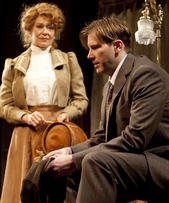
Orphans Home Cycle Part One at Hartford Stage
By Lauren Yarger
|
He's peculiar in many ways, I know, but he's been good to me and Lily Dale, and he has no bad habits.— Corella
.—
|
It was Wilson who commissioned the playwright to rework nine of his plays into a three-play cycle, which runs its world premiere through Oct. 24 at Hartford stage, in collaboration with New York's Signature Theater Company, where it opens November 5th. Wilson's love for the project shines through.
The Orphans' Home Cycle follows the lives of three families in the fictitious town of Harrison, TX and spans three decades. Some 22 actors play 70 roles on a sumptuous multi-purpose set by Jeff Cowie and David Barber that looks like a quilt-framed snapshot of days gone by, with the pictures in the frame shifting into the various rooms, porches and settings where that past played out.
The design team really has struck gold with the set (the opening sequence that graphically spells out, literally, the play about to unfold, is a marvel. The visual experience is enhanced by projection design by Jan Hartley that transforms a living room into a swamp and all of the scenes are enhanced by a wondrous array of sounds created by designer John Gromada. Bill Heck stars as Horace Robedaux who remembers details of his family life around the turn of the century. We see young Horace (played by a surprisingly deep Dylan Riley Snyder at age 12 and by able Henry Hodges at age 14) help his little sister Lily Dale (Georgi James, whose wig unfortunately looks like a wig and is the only thing that seems out of place in the production) deal with their parents separation and the alcohol-related death of their father Paul Horace (also played by Heck).
Abandoned by his mother Corella (played at different ages by Virginia Krull and Annalee Jeffries) when she remarries Pete Davenport (played by Bryce Pinkham and Devon Abner) who welcomes only Lily into his home, Horace is left to fend for himself and is sent to a distant uncle to take a job working among convicts. Finally, as a young man, he visits his mother, sister and stepfather, and finds he is as unwelcome as ever (he's only allowed to stay after a bout with malaria leaves him too weak to travel). The streak of selfishness that allowed a now regretful Corella to sacrifice him for her own security has flared in the self-absorbed Lily Dale who happily spends her time charming a beau and forcing everyone to listen to her play an endless etude on the piano.
A special treat is the casting of Foote's daughter Hallie in two roles in a work that largely is based on their own family's experiences. All of the performances, without exception, deserve highest praise. Even Pamela Wright, who probably has the least amount of stage time, stands out. She is a hoot as the well intentioned by bible-thumping elderly traveler Horace meets twice on the train.
The design team really has struck gold with the set (the opening sequence that graphically spells out, literally, the play about to unfold, is a marvel. The visual experience is enhanced by projection design by Jan Hartley that transforms a living room into a swamp and all of the scenes are enhanced by a wondrous array of sounds created by designer John Gromada.
Foote's story, deftly handled by Wilson, is warm, humorous, sad and absorbing. The three-hour runtime only leaves you waiting for Part 2, which will follow Horace into courtship and marriage.
Editor's Note: Production details, except for venue and running dates were the same at Hartford as at the Signature. Reviewed by Lauren Yarger based on Sept. 9, 2009
|
You can also contact us at Curtainup at Facebook or Curtainup at Twitter |
|
Subscribe to our FREE email updates with a note from editor Elyse Sommer about additions to the website -- with main page hot links to the latest features posted at our numerous locations. To subscribe,
E-mail: esommer@curtainup.comesommer@curtainup.com
put SUBSCRIBE CURTAINUP EMAIL UPDATE in the subject line and your full name and email address in the body of the message -- if you can spare a minute, tell us how you came to CurtainUp and from what part of the country. |

South Pacific

In the Heights
Playbill Broadway Yearbook