
SITE GUIDE
SEARCH
REVIEWS
REVIEW ARCHIVES
ADVERTISING AT CURTAINUP
FEATURES
NEWS
Etcetera and
Short Term Listings
LISTINGS
Broadway
Off-Broadway
NYC Restaurants
BOOKS and CDs
OTHER PLACES
Berkshires
London
California
New Jersey
DC
Connecticut
Philadelphia
Elsewhere
QUOTES
TKTS
PLAYWRIGHTS' ALBUMS
LETTERS TO EDITOR
FILM
LINKS
MISCELLANEOUS
Free Updates
Masthead
A CurtainUp Review
Leaving
|
With a little more time I would have given bribery and corruption a run for its money. As Havel once told me, popularity isn't everything.— Dr. Vilçm Rieger |
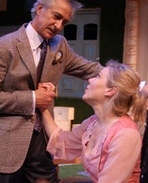
David Strathairn as Vilem Rieger and Kathryn Meisle as Irena
in Leaving.
(Photo: Wilma Theater) |
Last night President Havel was in the audience for the Wilma Theater's U.S. Premiere. An accomplished statesman and political writer, he is a skilled playwright with a light touch and an attractive way of tossing existential ideas around as he writes of power and accommodation, everyday political villains, flunkies, bossy women, and the controlled press. Co-Artistic Director Jiri Zizka, who has known Havel for quite some time, provides adroit and rather elegant direction.
The play's protagonist, popular former Chancellor Dr. Vilém Rieger (David Strathairn), recently out of office, sees a "vast intellectual and spiritual abyss between himself and the current power structure." The compromised new administration, which is the source of his woe —aside from his own character flaws and his family—- is represented by his political adversary, the underestimated Klein (Trevor Long), who parrots the chancellor's own slogan about putting the individual at the heart of government policies.
One twist that sets this farce/ morality play apart is the writer's offstage voice (recorded by F. Murray Abraham) commenting throughout on authorial whimsy, or reminding the actors not to use exaggerated facial expressions, listing various ways to get characters offstage, and worrying that he might mess up his stage directions, as well as more thematic thoughts. Havel must have enjoyed writing these asides.
The Cherry Orchard is a controlling metaphor that runs through the work, both subtly and outrageously. The chancellor learns that he may have to move out of his government owned villa. Later the ominous sound of trees being felled provides aural punctuation as the nemesis, Klein, now promoted to Vice Prime Minister, delights in listing the new commercial enterprises that will come in, once the trees in the orchard are gone. He imagines aloud the chancellor's villa reborn as a modern erotic entertainment club.
The family's manservant, Oswald, beautifully realized by Geddeth Smith, mentions that he will work for the Ragulins (of The Cherry Orchard). Food and drink are served often, and prescient Oswald anticipates every order. Also, like some Drosselmeyer or Obi Wan he quietly and magically oversees scene changes.
Along the way, shameless jokes include "something Molotov said over a cocktail," the idea of taking refuge in a Hovel, and a constantly reappearing bust of Gandhi (which may represent the hero's principles). Way over-the-top tragic references to King Lear, more sinned against than sinning, come complete with fortissimo thunder, brilliantly realized lightning, and rain.
David Strathairn plays Rieger, whom Havel has disavowed as an alter-ego. Nevertheless he's a character with similarities to Havel's situation. [Strathairn was nominated for an Oscar for his role as Edward R. Murrow in Good Night and Good Luck. No doubt many in the audience saw him in Dow's Cherry Docs at the Wilma in '00, and in the Stoppard /Previn Every Good Boy Deserves Favor, co-produced with the Philadelphia Orchestra in '02.]
Strathairn can deal with the role. He can run the gamut from gravitas to baggy pants. He never loses sight of the inherent humor as he serves up warmed over platitudes to a reporter (Leonard C. Haas), endures his family, succumbs to a comic dalliance. Initially he seems a hero, standing up to bullies and all, but we soon see that he is a reverse Candide, a stay-at-home whose misadventures don't wait on the road, but come to him, and his former optimism is replaced with sadder pragmatism. The gravity of his actual situation doesn't hit Rieger right away. More acted upon than acting, he doesn't give push-back, and he recognizes an endgame only when it is upon him.
Kathryn Meisle, reminiscent of a younger Kathleen Turner, plays Irena, Rieger's "long time companion".; She's a real piece of work who micromanages with zeal. She dislikes Rieger's infidelity, but what she really can't take is loss of face. In addition Rieger has two non-devoted daughters: a managerial daughter played by Jennifer R. Morris, whose hapless husband played by Mark Cairns, follows her and carries her purse, and a younger daughter (Victoria Frings), who lives in an electronically enhanced world of her own. Mary McCool is Bea, a grad student on the make, who claims she probably knows Rieger better than he does himself. Then there's his mother (Janis Dardaris), yet another problem--And Luigi Sottile is Victor, an assistant that the Chancellor had best keep an eye on.
The kooky set designed by Klara Zieglerova is all about doors. Notions about doors are expressed in the play, i.e., doors as borders between different worlds and the idea that there is something on the other side of a door. Doors of many colors, shapes and sizes decorate the walls and floor and co-exist with the outdoor courtyard in front of the villa, where the family and others gather, Chekhov-like, near a thin tree, at a table (made of a door).
As the second act winds down, the play is drowning in Rieger's lengthy rationalizations. Yet no matter how ridiculously and humorously self-indulgent Leaving may be, it is never self-important. By the end, the Chekhovian-Havelian momentum has picked up once again. Gently absurd and self-effacing, it is quite delightful theater that resists easy categorization.
This deceptively well crafted play is more complex and less untamed than it first appears to be. Havel finds so many laughs and incongruities as the characters deal with the hassles of displacement, the consequences of loss of power, and the disposition of belongings — what is one's own and what is the state's? And there's the making or avoiding of living arrangements, and the pressure of being squeezed, of reaching an arrangement with power.
There is stealth profundity at work in this simultaneously astute and playful theater piece, yet nothing appears to be taken too seriously here by this dissident turned savvy former head of state. If you go, and you should, you'll find that the years of accumulated wisdom seem to be saying, "c'est la vie, c'est la guerre", cue the music.
| Leaving
by Václav Havel Translator: Paul Wilson Directed by Jiri Zizka Cast: Krista Apple,Janis Dardaris, Mark Cairns, Mike Dees, Peter DeLaurier, Victoria Frings, Leonard C. Haas, Trevor Long, Mary McCool, Kathryn Meisle, Jennifer R. Morris, Geddeth Smith, Luigi Sottile, David Strathairn, H. Michael Walls Set Design: Klara Zieglerova Costume Design: Vasilija Zivanic Lighting Design: Jerold R. Forsyth Sound Design: Nick Rye May 19- June 20, 2010. Opening May 26 2 hours and 10 minutes includes one 15 min intermission. Reviewed by Kathryn Osenlund based on 05/26/10 performance. At the Wilma Theater |
|
REVIEW FEEDBACK Highlight one of the responses below and click "copy" or"CTRL+C"
Paste the highlighted text into the subject line (CTRL+ V): Feel free to add detailed comments in the body of the email. . .also the names and emails of any friends to whom you'd like us to forward a copy of this review. You can also contact us at Curtainup at Facebook , Curtainup at Twitter and at our Blog Annex . . . Curtain Up Blog Annex at Kindle |
|
Subscribe to our FREE email updates with a note from editor Elyse Sommer about additions to the website -- with main page hot links to the latest features posted at our numerous locations. To subscribe,
E-mail: esommer@curtainup.comesommer@curtainup.com
put SUBSCRIBE CURTAINUP EMAIL UPDATE in the subject line and your full name and email address in the body of the message -- if you can spare a minute, tell us how you came to CurtainUp and from what part of the country. |

South Pacific

In the Heights

Playbill Broadway Yearbook