SITE GUIDE
SEARCH
REVIEWS
REVIEW ARCHIVES
ADVERTISING AT CURTAINUP
FEATURES
NEWS
Etcetera and
Short Term Listings
LISTINGS
Broadway
Off-Broadway
NYC Restaurants
BOOKS and CDs
OTHER PLACES
Berkshires
London
California
New Jersey
DC
Connecticut
Philadelphia
Elsewhere
QUOTES
TKTS
PLAYWRIGHTS' ALBUMS
LETTERS TO EDITOR
FILM
LINKS
MISCELLANEOUS
Free Updates
Masthead
Writing for Us
A CurtainUp  London Review
London ReviewGilbert is Dead
|
Our desire for knowledge - its purest form, science - leads inexorably to heaven. We are led to the Garden of Eden by botanists and naturalists, to the holy spheres by our astronomers, by physicians, by surgeons to the seat of our very soul. But who is the closest to God? The taxidermist!— Lucius Trickett |
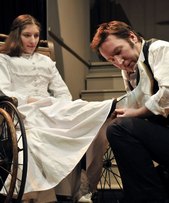
Kate Burdette as Lucille and Ronan Vibert as Lucius Trickett (Photo: Scott Wishart ) |
When the play opens the museum has been closed for four years and Trickett's creditors are demanding payment. William Chubb plays Meriwether, Lucius' physician friend called upon to make a report to the creditors and whose first task is to list the specimens. With a new museum being built in Kensington responding to the public's interest in natural history, there are others anxious to obtain Lucius' exhaustive and remarkable collection. In the context of the publication of The Origin of the Species, there is a heated debate in England between religion and evolution.
Robin French has used the controversy of this debate to underline the particular Darwinian challenge to those of a religious persuasion seeking comfort in God when they are bereaved. He introduces us not just to the widowed Lucius but to a delightful cameo of Queen Victoria (Kate Burdette) living in solitude at Osborne House on the Isle of Wight, after the death of her beloved Prince Albert. But French's play is not about questioning Darwin rationally but about the emotional space left by science when it tears away religion and faith.
Contrasting with the scenes in the museum, are some where the adventurer Gilbert Shirley (played by Ronan Vibert extravagantly moustachioed, in pith helmet and safari suit) intrepidly braves the high seas and the jungle in his quest to find his "missing link", a small species of loris. The Black Islands are peopled by what the Victorians called savages with loin cloths and large leather collars, amusingly worn over their capacious Victorian underwear.
The venue and the design are exquisite. This attention to design of course assists French's theme — with dead animals preserved for posterity, Lucius is surrounded by the dead in life. For a small company, what resourcefulness there has been to fill Lucius' museum room with first rate specimens which include a Black bear (unusually not rampant), a bird eating tarantula, a bright eyed meerkat, an armadillo and a marabou stork among many others. Changes from the museum scenes are facilitated by beautiful, printed cloth back drops illustrated in a Victorian style by Ian Bass. A giant green turtle puppet swims lyrically across the ocean, pulling Lucius to shore, as we hear about the turtle's loyalty to its dead mate. The naturalist sees a giant articulated centipede which needs two puppeteers to wiggle across the stage in a lighter moment. Even Lucille's wheelchair is a perfect period example in cane work. I liked to the creation of the storm using materials the Victorians would have had access to in order to sound thunder, the metallic thunder board effects.
Because there is a mystery element, I am forbidden from disclosing any more of the plot but there is much to smile or laugh at before the play which gives way to tragedy. The characterisation is interesting and quirky. Lucille isn't a typical Dickensian invalid but although physically weak, she is feisty and verbally caustic to the maid, Maisy Fellows (Suzan Sylvester). Lucille's nails have been made blue and eaten away by Arsenic used in taxidermy.
Kate Burdette gives a very strong performance exploring the contradictions of Lucille's character and her peremptory Victoria is delightful. William Chubb as Meriweather is upstanding and well intentioned although he makes the mistake of deciding what is best for others. Ronan Vibert's eccentric Lucius is complex and at times deliberately difficult to fathom. Robert Wolstenholme's sometimes jokey direction has echoes of Victorian entertainment as well as tender sentiment to complement Robin French's well written and original play.
|
Subscribe to our FREE email updates with a note from editor Elyse Sommer about additions to the website -- with main page hot links to the latest features posted at our numerous locations. To subscribe,
E-mail: esommer@curtainup.comesommer@curtainup.com
put SUBSCRIBE CURTAINUP EMAIL UPDATE in the subject line and your full name and email address in the body of the message -- if you can spare a minute, tell us how you came to CurtainUp and from what part of the country. |
| Gilbert is Dead
Written by Robin French Directed by Robert Wolstenholme With: Kate Burdette, William Chubb, Ronan Vibert, Suzan Sylvester Design: Christopher Hone Lighting: Rob Mills Puppet Maker: Seonaid Goody Illustrator: Ian Bass Composer: Nick Gill Fight director: Tim Klotz Running time: Two hours 15 minutes with one interval Box Office: 08444 771 000 Booking to 29th November 2009 Reviewed by Lizzie Loveridge based on 6th November 2009 performance at Hoxton Hall, 131 Hoxton Street, London N1 (Tube: Old Street) |
|
REVIEW FEEDBACK Highlight one of the responses below and click "copy" or"CTRL+C"
Paste the highlighted text into the subject line (CTRL+ V): Feel free to add detailed comments in the body of the email . . . also the names and emails of any friends to whom you'd like us to forward a copy of this review. |
|
London Theatre Tickets Lion King Tickets Billy Elliot Tickets Mighty Boosh Tickets Mamma Mia Tickets We Will Rock You Tickets Theatre Tickets |