
SITE GUIDE
SEARCH
REVIEWS
REVIEW ARCHIVES
ADVERTISING AT CURTAINUP
FEATURES
NEWS
Etcetera and
Short Term Listings
LISTINGS
Broadway
Off-Broadway
NYC Restaurants
BOOKS and CDs
OTHER PLACES
Berkshires
London
California
New Jersey
DC
Connecticut
Philadelphia
Elsewhere
QUOTES
TKTS
PLAYWRIGHTS' ALBUMS
LETTERS TO EDITOR
FILM
LINKS
MISCELLANEOUS
Free Updates
Masthead
A CurtainUp Review
The Three Lives of Avenue Q
Vineyard Premiere Review
Broadway Production Review
|
Avenue Q Moves Back to Off-Broadway
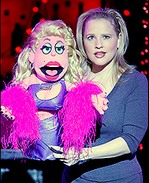
Along with the cast changes, and the more intimate setting (more like the Vineyard, less like the Golden pm Broadway), there are no major changes—the most noticeable and obvious being a switched satiric reference: From George W. Bush to Fox News. Current Production Notes Avenue Q at New World Stages 50th and Eighth Avenue 212/239-6200 www.avenueq.com. Current Cast: Anika Larsen (as Kate Monster/Lucy The Slut), Seth Rettberg (Princeton/Rod), Cullen Titmus (Nicky/Trekkie Monster), Danielle K. Thomas (Gary Coleman), Sala Iwamatsu (Christmas Eve), Nicholas Kohn (Brian) and Maggie Lakis (Mrs. Thistletwat/Bad Idea Bear). From 10/13/09; official reopening 10/21/09 Mondays, Wednesdays, Thursdays and Fridays at 8 PM, Saturdays at 2 and 8 PM and Sundays at 3 and 7:30 PM Ticketsfrom $86.50 to $66.50 |
You can contact us at Curtainup at Facebook or Curtainup at Twitter
|
Subscribe to our FREE email updates with a note from editor Elyse Sommer about additions to the website -- with main page hot links to the latest features posted at our numerous locations. To subscribe,
E-mail: esommer@curtainup.comesommer@curtainup.com
put SUBSCRIBE CURTAINUP EMAIL UPDATE in the subject line and your full name and email address in the body of the message -- if you can spare a minute, tell us how you came to CurtainUp and from what part of the country. |
| There's a fine fine line/ Between together and not/ There's a fine fine line/ Between what you wanted and what you got... ---Kate in "There's a Fine, Fine Line" |
The college graduate characters in Avenue Q no doubt grew up watching Sesame Street, as did, I assume, Mssrs. Lopez, Marx and Whitty, its writers. Their show pays homage to the Sesame Street gestalt. In addition to the interaction of humans (there are three in the cast) and puppets, the production relies on video monitors to supply familiar interludes teaching us spelling and vocabulary. The obeisance, however, has clearly come of age: the denizens of the Avenue confront adulthood, complete with its share of trials and tribulations as well as, not that surprisingly, sex.
Princeton (puppeteer John Tartaglia), having recently graduated from college, arrives in New York City with the obligatory (if imprecise) bag of dreams and the almost equally compulsory empty pockets. He stumbles onto Avenue Q ("I started at Avenue A," he tells the residents, "but everything so far is out of my price range.") There he meets an unemployed comedian, Brian (Jordan Gelber) and his Japanese wife-to-be, Christmas Eve (Ann Harada), an unemployed social worker; Nicky (puppeteer Phoebe Kreutz, Rick Lyon's voice) and his roommate Rod (puppeteer Tartaglia) who refuses to admit he's gay; Kate Monster (puppeteer Stephanie D'Abruzzo), an eligible young kindergarten assistant (for a while anyway) with whom Princeton quickly falls into, out of and eventually back in love); Trekkie Monster (the Lyon/Kreutz combo again), a semi-reclusive and very hairy internet sex freak; and Gary Coleman (Natalie Venetia Belcon), the child star who is now the building super. Princeton moves right in.
There's nothing complex about Avenue Q's story, nor should there be. Jeff Whitty has opened a window into a group of lives, managing to render them both funny and appealing. Puppets can get away with things onstage that humans would be upbraided for attempting. So can bookwriters for puppet shows. How would Avenue Q be received without the puppets? Not nearly as well. But why should we care? In the end, we care about our furry yet incredibly articulated new friends, and that's more than we can say about many flesh-and-blood characters we meet in the theater.
The puppet handlers are terrific. Their ability to convey mood and emotion is remarkable, and it infects the audience. Oftentimes in musicals, one must choose to cast actors who can sing or singers who can act. Here, the task is a degree more difficult, as the piece requires puppeteers who can both act and sing. The quartet of puppeteers may not be accomplished musical theater performers in their own right, but they acquit themselves well on all fronts. And they have stiff competition from Ms. Belcon, Mr. Gelber and, most especially, Ms. Harada.
The idea for Avenue Q originated in the minds of its composer/lyricist team, Robert Lopez and Jeff Marx. They met and began working on the show at the BMI Musical Theater Workshop, and their songs reflect that process. Musically, the songs reveal a range of musical theater styles without veering too far from the Sesame Street aesthetic. Though they don't necessarily expand the form, they produce satisfying results. Lyrically, too, their work has an accomplished feel, even if it sometimes strikes me as a bit formulaic.
If I have a bone to pick, it is that the show sometimes seems more anecdotal than unified. Thus, for instance, though much time is devoted to a sub-plot involving Nicky's crush on Rod and Rod's refusal to come out of the (deep) closet, there's not much of a pay-off. More acutely, there are a number of the songs ("Everyone's A Little Bit Racist" is a good example) that are not very tethered to the rest of the show. Not that they are not a lot of fun.
Beyond the technical wizardry of the puppeteers, a good deal of credit for what is achieved must go to director Jason Moore, who not only stages everything well, but seems especially facile in integrating his breathing and stuffed casts and in gaining a symbiosis (if that's not a contradiction) from their interaction. This show also boasts some excellent work from its designers, including a wealth of aptly clever ideas from set designer Anna Louizos.
Editor's Note:In the interest of maintaining the element of surprise and audience enjoyment, we've moved the song list to the following separate page
|
Avenue Q Music and Lyrics by Robert Lopez and Jeff Marx Book by Jeff Whitty Based on an original concept by Robert Lopez and Jeff Marx Directed by Jason Moore with Jennifer Barnhart, Natalie Venetia Belcon, Stephanie D'Abruzzo, Jordan Gelber, Ann Harada, Rick Lyon (Phoebe Kreutz assisting as puppeteer) and John Tartaglia Set Design: Anna Louizos Lighting Design: Frances Aronson Costume Design: Mirena Rada Sound Design: Brett Jarvis Music Supervision, Arrangements and Orchestrations by Stephen Oremus Puppets Conceived and Designed by Rick Lyon Music Director: Gary Adler Musicians: Michael Croiter, Mark Hartman and Patience Higgins Choreography: Ken Roberson br>A production of Vineyard Theatre and The New Group Running time: 2 hours with 1 intermission Vineyard Theatre, 108 East 15th Street (Union Square East/Irving Place) Opening March 19, 2003, April closing date not announced -- and extended to 5/04/03--and a third time to 5/11/03 -- with the final story: a move to the Golden Theater on Broadway in July where it will have an official opening July 31, 2003. . . a final closing set for 4/29/19. Reviewed by Les Gutman based on 3/18/03 performance |
Broadway Production: Avenue Q Becomes a Broadway Baby by Jenny Sandman
Hysterical. Truly hysterical. Avenue Q is Sesame Street meets The Simpsons with a touch of Sex and the City: Five! Five nightstands! One! One nightstand! Granted, it's somewhat traumatizing watching puppets have sex (and energetic sex at that). They also curse, flip people off, and sing about masturbating to Internet porn. You'll never watch The Muppet Movie in the same way again.
Avenue Q tackles what some have termed the "quarter-life crisis", that period of fear and self-doubt that afflicts twenty-somethings after college. Puppet Princeton is desperately seeking his purpose in life while trying to stay financially solvent at the same time. In fact, most of the characters are adrift, searching for some meaning or direction for their young lives. They make mistakes, sleep with the wrong people, get themselves fired and try desperately to find some meaningful connection to those around them. (In fact, the so-called Bad Idea Bears are one of the best and most original parts of the show-two cute bears who whisper what seem like good ideas at the time: "A six-pack? Why not a case?" "Let's play a drinking game!" "Feel her boob!") At the end, still somewhat adrift, the characters determine that they'll put up with their unanswered questions "for now" -- because everything in life is "for now."
For a puppet show, it's pretty cynical. But New Yorkers can take it. We like cynicism in healthy doses, especially when accompanied by funny songs and naughty jokes.
Avenue Q has all the earmarks of a hit; the Golden, while small, is just the right size for this show, and the production values are apparently a step up from the Vineyard. (Editor's Note: Our review of Avenue Q's premiere there follows Jennie's comments). Those who saw the original production (review of which follows these comments) have found the sets at the Golden to be less makeshift looking and the costumes to be gussied up. Plus the animations are now on large screen monitors. The puppeteers are Sesame Street veterans, and are good actors in their own right. It's definitely one of the most original shows in New York right now, and it's a welcome respite from the usual bland yet-another-revival Broadway fare.
|
AVENUE Q Golden Theater,252 W. 45 St. 212/239-6200 -- the theater which interestingly enough opened in 1927 with a play called PUPPETS OF PASSION. Author, director, cast and design credits per review following this box Running Time: 2 hours, includes one intermission. Mon through Sat @8PM, Wed & Sat @ 2PM --after 9/01/03, Tues through Sat @ 8PM, Sat & Sun @2PM, Sun @ 7PM --$86.25 & $46.25  OK for ages 18 and up. Don't let the puppets fool you. This is NOT a kids show but has a primary audience of twenty-somethings-- with a tertiary audience of teenagers, older folks remembering their own struggles with growing up and watching their kids and grandkids go through the same process. OK for ages 18 and up. Don't let the puppets fool you. This is NOT a kids show but has a primary audience of twenty-somethings-- with a tertiary audience of teenagers, older folks remembering their own struggles with growing up and watching their kids and grandkids go through the same process. Final performance: 9/13/09 Editor's Note: In the interest of maintaining the element of surprise and audience enjoyment, we've moved the song list to the following separate page |

South Pacific

In the Heights
Playbill 2007-08 Yearbook

Leonard Maltin's 2008 Movie Guide