
SITE GUIDE
SEARCH
REVIEWS
FEATURES
NEWS
Etcetera and
Short Term Listings
LISTINGS
Broadway
Off-Broadway
NYC Restaurants
BOOKS and CDs
OTHER PLACES
Berkshires
London
California
New Jersey
DC
Philadelphia
Elsewhere
QUOTES
TKTS
PLAYWRIGHTS' ALBUMS
LETTERS TO EDITOR
FILM
LINKS
MISCELLANEOUS
Free Updates
Masthead
Writing for Us
A CurtainUp Review
The Vietnamization of New Jersey
By Brad Bradley
|
You folks sure make a mess.— Hazel.
|
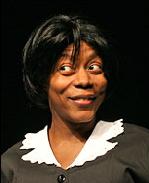
James Duane Polk in The Vietnamization of New Jersey.
(Photo: Trevor Oswalt) |
This play is much influenced by some of Durang's predecessors in both inanity and irreverence, ranging from fairly obvious television allusions to sitcoms of the 50s and 60s, notably The Adventures of Ozzie and Harriet (happy but bland American middle-class family) and Hazel (sassy but endearing maid who takes no guff), to considerably lower profile, although notably bitingly successful, stage plays. Two of the latter must be mentioned— Thornton Wilder's 1943 comedy, The Skin of Our Teeth, and David Rabe's 70s Vietnam dramatic satire, Sticks and Bones.
In an early line, the family's black maid, herself called Hazel, correctly observes to her employer family, "You folks sure make a mess." James Duane Polk deftly lets his maleness disappear in the role, so much that my usually astute companion didn't even observe that the role was not played by a woman. In fact, Polk's deliberately detached performance as the only continuing character really looking outside the action is easily the most effective on the Beckett stage for he is able to directly connect with Durang's scripted irreverence. He successfully channels sufficient amounts of the iconic television Hazel played by Shirley Booth and even of Wilder's stage maid Sabina, that searing Tallulah Bankhead performance known only from reviews and a few still photographs. This play is at its most biting when Hazel offers her version of 1976 broadcasting's "bicentennial minutes."
The play's family members' often absurd actions are not well served by realistic acting and need a different approach. Frank Deal as Harry, the father , reflects the blandness of the family that ultimately hurts the production; by contrast, when he reappears as that character's aggressive military brother Larry, the contrasting energies on stage happily give the show a welcome edge. Additional value is brought by another outsider, Father McGillicutty, who in a cameo of one scene smartly played by Michael Cyril Creighton, shockingly but memorably observes that war is a convenient means of population control.
The family members at the play's center are deliberate stand-ins for Ozzie and Harriet Nelson and their squeaky clean sons David and Ricky, broadcasting regulars for more than a decade and iconic ever since. Previous even to the Yale production of this play in 1977, the Nelsons had been employed in Rabe's Vietnam era anti-war satire with considerably more bite. Here in the land of Durang the names are more playful than direct copies from the television show, and present a curious puzzle that is never referred to on stage. The mother, no longer called Harriet, is Ozzie Ann, whereas her husband is Harry instead of Ozzie. With older son David still serving in Vietnam as the play begins, he of course is off stage, but his brother is present, here named Et rather than Ricky. Now, don't give up on this! Not until studying the cast list in the program can one realize that the first three family members on stage are as follows: Ozzie Ann, Harry, Et. Say them quickly and they match the sounds heard at the end of the television title The Adventures of . . .Ozzie and Harriet.
All performers portraying the family quartet are fine in moments, but would be so much more effective if some irony were permitted to seep through Durang's preposterous situations. Some of the social criticisms, such as a response to David's returning home blind (What is worse, physical blindness or moral blindness?) or an all-too-timely appeal for troop withdrawal, land with a thud rather than useful irony. Unfortunately, when Blanche Baker as Ozzie Ann says, "Oh, my God, I'm talking nonsense," her comment is taken all too literally.
David's war bride Liat, who seems to be another blind person and a Vietnamese refugee, turns out to be quite something else and takes the satire in another bizarre direction when we learn she really is from Schenectady, not Vietnam, and always has wanted to be in The King and I. In fact, she even sings from that most exotic of that team's shows. There is even more for musical fanatics: all three of Rodgers and Hammerstein's "Asian musicals" are alluded to in her kooky warbling. Susan Gross's spunky performance in the role is a definite asset.
While the set design clearly has been done on the cheap (cardboard walls, for example), empty frames in front of a scrim or cyclorama could have been more effective. If nothing else, the set could have accented the play's cartoon manner to great effect. Also items on stage which are never used merely clutter an already burdened space. A constantly present Christmas tree in the living room and a religious statue in the front yard are entirely distracting and never commented upon.
For diehard Durang fans, this show is a rare opportunity to see a play they probably never even knew. For others, remember that you were warned. Editor's Note: For a more up-to-date Durang experience, there's his musical collaboration with Peter Melnick, Adrift in Maccao which premiered in Philadelphia and which will soon open at Primary Stages. Until my review of that production, check out the Philadelphia review here.
|
The Vietnamization of New Jersey
Written by Christopher Durang Directed by Robert Saxner Cast: Blanche Baker, Frank Deal, Nick Westrate, James Duane Polk, Corey Sullivan, Susan Gross, and Michael Cyril Creighton. Set Design: Amanda Rehbein Costume Design: Abby O'Sullivan Lighting Design: Ku'uipo Curry Sound Design: Scott O'Brien Alcemy Theatre Company Beckett Theater at 410 West 42nd Street From 1/11/07 to 1/28/07; opened 1/16/07 Running time: 1 hour, 45 minutes including one intermission. Tuesday to Saturday at 8; Sunday at 2. Viewed by Brad Bradley at the Saturday, January 13 press preview. |
Easy-on-the budget super gift for yourself and your musical loving friends. Tons of gorgeous pictures.

Leonard Maltin's 2007 Movie Guide
At This Theater
Leonard Maltin's 2005 Movie Guide

 >
>