
SITE GUIDE
SEARCH
REVIEWS
REVIEW ARCHIVES
ADVERTISING AT CURTAINUP
FEATURES
NEWS
Etcetera and
Short Term Listings
LISTINGS
Broadway
Off-Broadway
NYC Restaurants
BOOKS and CDs
OTHER PLACES
Berkshires
London
California
New Jersey
Philadelphia
Elsewhere
QUOTES
TKTS
PLAYWRIGHTS' ALBUMS
LETTERS TO EDITOR
FILM
LINKS
MISCELLANEOUS
Free Updates
Masthead
A CurtainUp Los Angeles Review
Trainspotting
By Jon Magaril
|
"Smack's an honest drug... Ye see the misery ay the world as it is. "— - Mark Renton
|
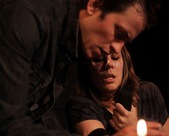
Justin Zachary, Libby Letlow (Photo credit: Tyler Wade Johnston)
|
Harry Gibson's stage adaptation of Irvine Welsh's cult novel requires a difficult balancing act between reckless abandon and feckless inertia. Danny Boyle's heralded film version hummed along on the rush of the first flush of heroin through the system. It depicted its gang of young layabouts from inside their sensations.
Gibson and Mathey focus more on their affectless demeanor. They find Joe Orton-esque cutting comedy in the grotesqueries of nihilistic behavior. It gets the feces just right. There's feces in sheets, feces in underwear, feces flung from a toilet bowl. It's a feckin' lot of simulated feces. And a feckin' lot of simulated feckin'. All of it is as funny as it is in-your-face.
It also does well by the full-frontal nudity and the shooting-up and the shooting-up with full-frontal nudity - for when a young addict's last good vein is in his penis. AJ Jones as Tommy does that last bit with admirable nonchalance. The young women bring a punk gusto to their disrobing that prevents a sense of exploitation.
David Agranov's terrific fight choreography is a prime example of how the production's precision allows the audience to take in the bleak comic tone rather than fear for the performers' safety or self-respect. There's a galvanizing finesse in the fight between a young man and woman that would be useful in some other areas of the production.
The staging of transitions between scenes, the stage and sound design are merely functional when boldness might help the two-and-a-half hour production rise towards its climax rather than plateau long before it. The ends of each act, for example, halt awkwardly. Scenes too often hold for a few beats while waiting for a lighting transition.
By the same token, Justin Zachary as the chief narrator Mark Renton is accomplished and amiable but doesn't chart many gradations or contrasts. Admittedly, t's a tricky part. Renton doesn't act heroically or even anti-heroically. He doesn't take decisive action all that often. And when he does, he can't keep it up.
After seeing that Alison, a fellow addict, has let her baby die of neglect, Renton goes straight — but just for a while. He does little to help when Tommy's destructive slide gets far steeper than his own. It may be true to life that these moments aren't treated with melodramatic twists and turns, but Zachary could find small flag-posts to swoosh around, more points of resistance and capitulation to Renton's weakness. Remarkably though, he keeps us on his side.
The same holds true of Mathey's production, which boasts many scenic highlights. Dialogue consultant Louise Linton has done tremendous work corralling the large cast into the same basic region. Audibility suffers only with Sick Boy's Martin George Berishaj, who just needs to speak up, and Martin J. Riddell. His off-hand approach to Begbie's violent acts makes him all the more frightening. But his words mush together to the point of indecipherability.
Mathey does best by the women, who show spine and self-awareness. Letlow gives the production's strongest performance. Most roles are double-cast, so the level of accomplishment and sense of ensemble is remarkable.
Near the play's end, Alison warns Renton that he's getting too old for his behavior. Mathey's production first ran a decade ago to award-winning acclaim with Zachary and several other cast members. Those actors' older age bring the sense of a ticking clock to characters who are on the verge of becoming human train-wrecks. The production triumphs over the same risks, taking care that we reach our destination shaken perhaps but bracingly entertained.
|
Trainspotting by Harry Gibson Based on the novel by Irvine Welsh Directed by Roger Mathey Friday and Saturday cast: Justin Zachary, David Agranov, Matt Tully, Alison Walter, Jonathan Roumie, Martin J. Riddell, Katy Townsend, Francesca Manzi, Katie Aquino, Sam Bangs, Travis McHenry, Elizabeth Knowelden, and Ben Wilson Sunday cast: Justin Zachary, AJ Jones, Libby Letlow, Martin Berishaj, Martin J. Riddell, Sarah Bauer, Francesca Manzi, Katie Aquino, Sam Bangs, Travis McHenry, Elizabeth Knowelden, Karl Wade, and Michael Lutheran Scenic Design: Jason Rupert Lighting Design: Michael Mallinson Sound Design: James Dethlefsen and Brian Palla Costume Design: Traci Ladue Production Stage Management: Danielle Korman Elephant Theatre 6322 Santa Monica Blvd. Los Angeles, CA 90038 323.960.7785 Runs Friday to Sunday through April 13 Running time: 150 minutes, including intermission Reviewed by Jon Magaril |
|
REVIEW FEEDBACK Highlight one of the responses below and click "copy" or"CTRL+C"
Paste the highlighted text into the subject line (CTRL+ V): Feel free to add detailed comments in the body of the email. . .also the names and emails of any friends to whom you'd like us to forward a copy of this review. Visit Curtainup's Blog Annex For a feed to reviews and features as they are posted add http://curtainupnewlinks.blogspot.com to your reader Curtainup at Facebook . . . Curtainup at Twitter Subscribe to our FREE email updates: E-mail: esommer@curtainup.comesommer@curtainup.com put SUBSCRIBE CURTAINUP EMAIL UPDATE in the subject line and your full name and email address in the body of the message. If you can spare a minute, tell us how you came to CurtainUp and from what part of the country. |
 Anything Goes Cast Recording
 Book of Mormon -CD