SITE GUIDE
SEARCH
REVIEWS
REVIEW ARCHIVES
ADVERTISING AT CURTAINUP
FEATURES
NEWS
Etcetera and
Short Term Listings
LISTINGS
Broadway
Off-Broadway
NYC Restaurants
BOOKS and CDs
OTHER PLACES
Berkshires
London
California
New Jersey
DC
Philadelphia
Elsewhere
QUOTES
TKTS
PLAYWRIGHTS' ALBUMS
LETTERS TO EDITOR
FILM
LINKS
MISCELLANEOUS
Free Updates
Masthead
Writing for Us
A CurtainUp  London Review
London ReviewThe Tragedy of Thomas Hobbes
|
Is this what comes with Progress?
Theatre is dead. King is chopped and abolished in a basket, So all Pomp and Mirth are flown away, From this barren land, exchanged instead for Dire, Vicious, grey-hot Politic— Black |
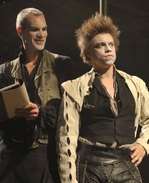
Angus Wright (Rotten) and James Garnon (Black)
(Photo: Hugo Glendinning) |
The play opens just after the end of the English Civil War, with Oliver Cromwell in power, whose draconian moralistic measures include the closure of theatres. Instead, dramatic energies and stage dynamism are channelled into fiery scientific enquiry and debate. Spanning the founding of the Royal Society, the Great Fire and subsequent rebuilding of London, a whole array of famous historical characters populate the stage, including Robert Boyle, Robert Hooke and Thomas Hobbes. Encompassing such breadth, the play is no less than a sprawling survey of the era and is reminiscent of Platonic dialogue in places with instructive dialectic, but also of Thucydides with rhetoric, political factions and instability of power.
In spite of the classical themes, the writing is naturalistic, well-paced and feels contemporary. The accessibility of the play's action is vastly helped by the device of two actors (played by James Garnon and Angus Wright) who are exiled from the stage and infiltrate the world of scientific endeavour, rivalries and recriminations. Although the theatres are closed, their " make-up won't wash off" and they enjoy a certain amount of complicity with the audience, both as stage characters and as ignorant outsiders to the science-philosophers' clique. Also adding some light relief is Arsher Ali's amusing Charles II, the dispossessed delinquent who assumes an air of relaxed debauchery as King.
Stephen Boxer's Thomas Hobbes is wizened and garrulous, with a fine balance between cantankerous pugilism and fearful pusillanimity. His arch enemy Robert Boyle, is the only cross-dressed part, played by Amanda Hadingue, he is effete, pious and gentle. His protégé Robert Hooke, engagingly played by Jack Laskey, is idealistic, gangly and sports a shock of wild hair. Arguably more the centre of attention than even Thomas Hobbes, he progresses from a bought, promising apprentice into a position of established but assailed dogmatism. Although these three characters represent some of the brightest minds of the period and their individual legacies to science are immense, their ideas are not really the focus of the play, rather than the roles they inhabit or grow into and the relationships between them.
The design by Soutra Gilmour features modern elements interspersed into the conventional surface. So, for example, although most of the cast are in traditional dress, Isaac Newton (Will Sharpe) wears white skinny jeans and the Restoration celebrations are remarkably similar to a punk disco. The music is informed by a similar hybrid, with an offstage string trio featuring an electronic cello.
Running at two hours forty-five, this play can feel a bit superfluous in places and there are a few extraneous characters and scenes. Plays based on historical facts often fall into a similar trap, when writers become caught up in the fascinating biographical minutiae. In their desire to reproduce every detail of the truth onstage, the coherent thematic impetus of the play and the thread of the plot is overshadowed. Nevertheless, the energetic cast and the writing counteracts much of this, with well-aimed dialogue and nicely-poised characters.
|
The Tragedy of Thomas Hobbes
Written by Adriano Shaplin Directed by Elizabeth Freestone With: Arsher Ali, William Beck, Stephen Boxer, Keir Charles, John Paul Connolly, Simon Darwen, Adrian Decosta, Leonard Fenton, James Garnon, Amanda Hadingue, Jack Laskey, Will Sharpe, Peter Shorey, Larrington Walker, Angus Wright. Designer: Soutra Gilmour Lighting: Johanna Town Music and Sound: Adrienne Quartly Movement: Anna Morrissey Running time: Two hours 45 minutes with one interval Box Office: 0844 800 1110 Booking to 6th December 2008 Reviewed by Charlotte Loveridge based on 19th November 2008 performance at Wilton's Music Hall, Graces Alley, Off Ensign Street, London, E1 8JB (Tube: Tower Hill) |
|
REVIEW FEEDBACK Highlight one of the responses below and click "copy" or"CTRL+C"
Paste the highlighted text into the subject line (CTRL+ V): Feel free to add detailed comments in the body of the email and state if you'd like your comments published in our letters section. |
|
London Theatre Tickets Lion King Tickets Billy Elliot Tickets Mighty Boosh Tickets Mamma Mia Tickets We Will Rock You Tickets Theatre Tickets |