
SITE GUIDE
SEARCH
REVIEWS
FEATURES
NEWS
Etcetera and
Short Term Listings
LISTINGS
Broadway
Off-Broadway
NYC Restaurants
BOOKS and CDs
OTHER PLACES
Berkshires
London
California
New Jersey
DC
Philadelphia
Elsewhere
QUOTES
TKTS
PLAYWRIGHTS' ALBUMS
LETTERS TO EDITOR
FILM
LINKS
MISCELLANEOUS
Free Updates
Masthead
Writing for Us
A CurtainUp Review
The Persecution and Assassination of Jean-Paul Marat as Performed by the Inmates of the Asylum of Charenton Under the Direction of the Marquis de Sade
|
Starting with its title, everything about this play is designed to crack the spectator on the jaw, then douse him with ice-cold water, then force him to assess intelligently what has happened to him, then give him a kick in the balls, then bring him back to his senses again.—
Peter Brook
|
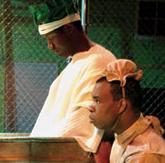
Nathan Hinton and Jonathan Payne star in a Classical Theater of Harlem production of Peter Weiss' Marat/Sade.
|
At the time of its production in 1966, Brook (in a homage to Brecht known for his "theatre of alienation") was looking for a play that would break down the barrier between the theatre and the outside world. Marat/Sade manages to be both Brechtian and Artaudian ("theatre of cruelty"). It's a multi-layered theatrical tour-de-force and a bloody and unrelenting depiction of human struggle and suffering.
The play within a play structure demands the audience to play a role, as well as the actors. The inmates of the Charenton Asylum in France are performing a play in 1808 written and directed by the Marquis de Sade (then an inmate) about the killing of French revolutionary Jean-Paul Marat in 1793. The director of the hospital, Coulmier, supervises the performance, accompanied by his wife and daughter. He supports the post-revolution government led by Napoleon, and believes the play to be an endorsement of contemporary political views. The inmates, however, have other ideas, and intentionally deviate into previously suppressed lines or personal opinion. At the very end of the inmates go berserk and stage their own revolution against their keepers.
The play takes place in three different time periods (1808, 1793, and the present), and in three different places (Marat's house, the bathhouse of the lunatic asylum, and the stage itself). The audience, then, is the audience both of Marat/Sade and of the 1808 performance. There is no linear plot building toward a traditional climax, just an unfolding montage of different episodes. The main focus is on the intellectual friction and debate between Marat and de Sade. The action, such as it is, builds to the murder of Marat, but Marat/Sade is really about subjugation and revolution. And it's all in rhymed verse!
Classical Theatre of Harlem's production maintains a fever pitch. It's a difficult work to do right. Te temptation is to let the natural insanity of the asylum inmates overpower the revolutionary ideas they are trying to express. But the genius of the play is that it pits revolutionary ideas of freedom and democracy against human limitations. Ultimately, the grand ideas spin into chaos and the inmates lose control of themselves and their message—much as all revolutions begin with grand ideas and then spin into chaos.
CTH's asylum is a chain-link cage set around a white tile floor, festooned with flickering fluorescent lights. Two pits hold water hoses and restraints. A steel bathtub holding Marat is mounted on a swiveling platform in the middle of cage with the audience is seated around three sides of it, with more steel caging behind them. The inmates (and there are a lot of them (more than forty actors in a very small space) fill both the cage and the area behind the audience, literally surrounding them.
As the backdrop for madness and revolution, the set is both unrelentingly oppressive and very effective. The dominant colors are gray and white. The inmates are all dressed in white institutional uniforms and their heads are shaved. They roam around this bleak setting, led by warders and de Sade — on crutches, bandaged and straitjacketed and obviously mad.
The play is technically a musical, though it's not like any other musical you've ever seen. The songs are set to tinny recorded music and the inmates clearly have no natural singing ability. As there are no female inmates, ome attempt to sing in falsetto.
T. Ryder Smith gives a perfectly pitched performance as de Sade. He is an imperious, dissolute nobleman who may be completely mad or who may be completely sane. He rules the production with an iron fist, but at the same time, allows the inmates to periodically spin out of control. He could stop them if he wanted to, but instead he prefers to watch. You see, he wants this play to be a celebration of insanity. The one scene in which he allows his natural proclivities to get the better of him is terrifying and disturbing and the only time we see de Sade not in complete control of himself. (De Sade's writings, which advocated extreme personal and sexual freedom unrestrained by morality, religion or law, led to the term sadism. Though never convicted of any crime, he spent 29 years in a series of prisons, including the Bastilleand insane asylums, where he did most of his writing which included his infamous "Sex without pain is like food without taste.").
The ensemble performances are marvelous. It's easy to play the inmates as stumbling, drooling spastics, but these actors imbue their charcters with far more humanity than their situation would suggest. The choreography is perfect: the cage, a swirling mass of people, never allows the audience a central focal point, but never obscures the scene at hand. There's a collective air of hopelessness crossed with ebullience, with the word "freedom" inciting a shouting frenzy. However,, as de Sade says, "My patriotism is bigger than yours." Like the mob of the French Revolution, the inmates' only voice can be collective. Dana Watkins as Marat's killer, Charlotte Corday, is the most vulnerable and so the most memorable of the inmates.
The production is full of fever and passion and disorder, and the most disturbing thing about it is that it' seems so familiar. The incendiary political ideas of the French Revolution are ones to which America is fiercely committed, but it's easy to forget that these ideas were born in a bloodbath and the Reign of Terror,— that almost all recorded political revolutions have ended in chaos. Seeing the inmates preaching equality and freedom ( though many probably don't understand one word they're saying), then singing, "What's the point of revolution without general copulation?" brings thoughts that revoution spawned America, born of a revolution, has always skirted the edge of chaos and mobocracy. As de Sade disdainfully reminds us with a single look at the very end of the play, e are more like the inmates of Charenton than we'd like to admit.
|
The Persecution and Assassination of Jean-Paul Marat as Performed by the Inmates of the Asylum of Charenton Under the Direction of the Marquis de Sade Written by Peter Weiss Directed by Christopher McElroen Cast: T. Ryder Smith (Marquis de Sade), Nathan Hinton (Marat), Ron Simons, Dana Watkins (Charlotte Corday), Daniel Talbott, Andrew Guilarte, Eric Walton, Jonathan Payne, James Rana, Danny Camiel, David Ryan Smith, Alexander Sovronsky, Bill Corry, Carl Louis, Chandler Wild, Donald Kingston, Eric Steven Mills, Erwin Falcon, Glenn Gordon, Jake Lemmenes, Jamal Niamke Bruce, Jaime Robert Carrillo, Jeffrey Glaser, Kiel Perry, Lesley Billingslea, Michael Flood, Mitch Maguire, Musa Bacon, Paul Krasner, Ricardo Perez-Gonazalez, Rommel Tolentino, Scott Sortman, Thomas Layman, Vladimi Versailles, Seth Lewandowski, Richard Vincent Weber, Rob Freedman, Tyshawn Major, Joi Sears Musical Director: Kelvyn Bell Choregrapher: Rajendra Ramoon Maharaj Set Design: Troy Hourie Costume Design: Kimberly Glennon Lighting Design: Aaron Black Fight Choreographer: Denise Hurd Running Time: One hour and forty-five minutes, with no intermission Classical Theatre of Harlem, HAS Theatre, 647 St. Nicholas Avenue; 212-868-4444 02/02/07—03/07/07 Tickets $36; Wednesday through Saturday at 8 pm, Sunday at 3 pm Reviewed by Jenny Sandman based on February 15th performance |
Easy-on-the budget super gift for yourself and your musical loving friends. Tons of gorgeous pictures.

Leonard Maltin's 2007 Movie Guide
At This Theater
Leonard Maltin's 2005 Movie Guide

 >
>