
SEARCH
REVIEWS
FEATURES
NEWS
Etcetera and
Short Term Listings
LISTINGS
Broadway
Off-Broadway
NYC Restaurants
BOOKS and CDs
OTHER PLACES
Berkshires
London
California
DC
Philadelphia
Elsewhere
QUOTES
On TKTS
PLAYWRIGHTS' ALBUMS
LETTERS TO EDITOR
FILM
LINKS
MISCELLANEOUS
Free Updates
Masthead
A CurtainUp Review
Hecuba
By Shirley Safran
|
Child, my child I’ll raise you a song, the measure that vengeance enacts. Made wild, I learn new strains of grief. --- Hecuba |
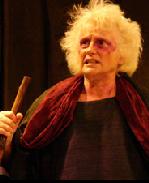
Joanne Camp in Hecuba
(Photo: Matthew Shane Coleman) |
Set on the Thracian peninsula, the play charts the descent of Hecuba from grief and mourning to acts of revenge and madness. This is not only a mother’s cri de coeur, but an unblinking depiction of the human costs and sacrifices of war.
Euripides, the last and youngest of the three great tragedians, and a contemporary of Sophocles, was the most fiercely critical of the Athenian wars, and both Hecuba and The Trojan Women depict the degradation and futility of war through the eyes and experiences of its most pathetic victims: women and children. In this clear, concise (90 minutes) and workmanlike translation by Janet Lembke and Kenneth J. Rackford, the playwright’s intentions are well served.
In the opening scene, the ghost of Polydorus reveals the circumstances of his death, as yet unknown to Hecuba, and foretells the death of his sister Polyxena at the hands of Odysseus. Hecuba begs him to spare her life which he coldly refuses to do. Polyxena, on her part, refusing to live as a slave accepts and embraces death. Hecuba soon discovers her son’s body and thus begins her transformation from grieving mother to implacable instrument of revenge. "Justice is mine", she declares, with tragic consequences.
It is tempting to conflate the follies of war and the political miscalculations of the Greeks with those of today's leaders. Fortunately, this translation avoids facile parallels of a political nature. The state of continuous war in Greece, with its unrelenting savagery sanctioned by politicians’ pious rationalizations, attests to the play’s universality. However, it is the individual human suffering, underscored by Hecuba’s lamentations and echoed by the women’s chorus that suffuses the play with pathos. The never ending cycle of revenge eventually robs everyone of moral authority and renders all action, personal and political, as essentially amoral. Coincidentally, Steven Spielberg’s controversial new film Munich, which follows a team of Israeli operatives charged with avenging the assassination of Israeli athletes during the 1972 Olympics, arrives ultimately at a similar conclusion. Hecuba, confronting both Agamemnon and Polymestor, King of Thrace, who murdered Polydorus for gold, taking a page out of Medea (so to speak), kills Polymestor’s two sons, rips out his eyes and descends into ferocity and madness.
The director, Shepard Sobel, wisely chose to keep the visual production simple, monochromatic and dignified. Generally, I find Greek choruses somewhat problematical: the lyrical passages not quite music and the choreographed movement not quite dance. Given the play’s content, the chorus might have been less restrained, more horror-struck, especially since they assisted Hecuba in killing Polymestor's sons.
The strongest impressions by individual actors were made by John Livingston Rolle, doubling as Odysseus and Agamemnon and by Dominic Cuskern, also double cast -- as Talthybius, a Greek herald; and Polymestor in whose blindness he was quite magnificent. Masks were used to differentiate their characters, yet the performances were powerful and sonorous.
While Joanne Camp as Hecuba had some effective moments of anguish and despair, her performance had a fitful and vocally underpowered quality that made it difficult to identify with her.There was more intensity in her make-up and white fright wig than in her line readings. What the role requires is an emotional tsunami; what we got were blustery winds and some rain.
Ultimately, this play speaks to us on a profoundly human level: war, power politics, cruelty, revenge--it’s all personal. Therein lies the real tragedy.
| HECUBA Written by Euripides Translated by Janet Lembke & Kenneth J. Reckford Directed by Shepard Sobel Cast: Joanne Camp, Rachel Botchan, Dominic Cuskern, Carol Schultz, Vinie Burrows, Mel England, Rocelyn Halili, Kelli Holsopple, Susan Hunt, Carolyn Ratteray, John Livingstone Rolle, Bashir Solebo Set Design: Susan Zeeman Rogers Costume Design: Devon Painter Lighting Design: Stephen Petrilli Sound Design: Jane Shaw Running time: 90 Minutes, without an intermission br>Pearl Theatre Company, 80 St Marks Place (212) 598-9802 www.pearltheatre.org Thu - Sat at 8pm; Wed, Sat, Sun at 2pm From 1/05/06 to 2/12/06; opening 1/15/06 Tickets: $25 Reviewed by Shirley Safran based on Jan, 15th matinee performance. |

The new annual to dress up every Broadway lover's coffee table
Easy-on-the budget super gift for yourself and your musical loving friends. Tons of gorgeous pictures.



>6, 500 Comparative Phrases including 800 Shakespearean Metaphors by our editor.
Click image to buy.
Go here for details and larger image.