
SEARCH CurtainUp
REVIEWS
FEATURES
NEWS (Etcetera)
ADDRESS BOOKS
Broadway
Off-Broadway
BOOKS and CDs
OTHER PLACES
Berkshires
London
Los Angeles
Philadelphia
Elsewhere
QUOTES
On TKTS
LETTERS TO EDITOR
FILM
LINKS
MISCELLANEOUS
Free Updates
Masthead
NYC Weather
Ferdydurke
by Les Gutman
|
Teacher: ...so I repeat once more, gentlemen: a great poet Juliusz Slowacki, a great poet, we love and admire his poetry because he was a great poet. .... Student: But I don't admire it at all! Not at all!.... I don't understand how I can admire it when I don't admire it. Teacher: How can you not admire it... when I told you a thousand times that you do admire it. ---Witold Gombrowicz, as translated by Danuta Borchardt |
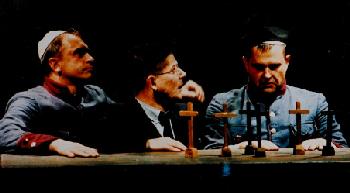
Jaroslaw Tomica, Witold Mazurkiewicz and Michal Zgiet (Photo: Bozena Bultowicz)
|
It was Blaise Pascal who posited that man is a paradox, its poles being body and mind. In Witold Gombrowicz's formulation, a man, Joey (Witold Mazurkiewicz), who has "recently crossed the Rubicon of [age] thirty," confronts the contradiction between his corporeal maturity and the immaturity of his soul. He awakes into a transitive state in which he is abducted by an old teacher, Pimko (Jacek Brzezinski), and transported back to a classroom where three "innocents" (he and his classmates, portrayed by Jaroslaw Tomica and Michal Zgiet) eschew conformity and embrace lust. It is a remarkable journey, shared in variously breathtaking fashion by the reader of the novel or, in this stage adaptation thereof, the audience.
Ferdydurke was Gombrowicz's first novel, a follow-up to a group of short pieces he had written previously (they were originally published in periodicals) that formed the content of his first published volume, Memoirs of a Time of Immaturity. The central theme of both is an embrace of immaturity, the social disparagement of which leads to a blind acculturation here expressed in terms of things like class distinctions and authority figures, but the subversiveness of which is more telling when it is put in the context of its time -- the 1930's, at the rise of Hitler. Although the novel received wide attention throughout Europe during Gombrowicz's lifetime, and is regarded by many as one of the great novels of the 20th Century, it was successively banned in his native Poland (from which he was inadvertently absent as the Second World War began, and to which he never returned) first by the Nazis, then by the Communists. That it was all but ignored in English-speaking countries can be attributed to a particularly poor and incomplete translation, a defect recently rectified with the publication of Danuta Borchardt's excellent (and award-winning) rendition, which is the basis for the play.
Borchardt notes that there was doubt that the book, inextricably bound to Polish culture, could be translated into comprehensible English. One might have asked the same question about the notion of staging it. Ferdydurke is, after all, a wild and outrageous cavalcade of childish pranks, sexual adventure (of all persuasions) and psychological spear-tossing. How could it possibly be reined in enough to be rendered coherently?
The simple answer, perhaps, is that it cannot; yet it is in that spirit that it finds its way.
There are two great successes in the staging of the book, and one (not unrelated) failure. The latter, interestingly enough, fades as one leaves the theater and finds time to let the import of what has transpired sink in. It becomes, one begins to discover (especially if compelled to go back and read the book, as I was), a key to the production's success.
The first success is in finding a way to reduce the essence of the book to seventy-five minutes of theater. This is achieved by seizing on Gombrowicz's iconoclastic anarchy and deftly translating it into theatrical terms. (The New York Times Arts and Leisure feature about the show, which appeared on the morning before the official opening, calls it "wild," which strikes me as a misnomer that misapprehends its thrust.) The second, to execute it with unrelenting humor (of an absurdist sort, but distinguishably so) and performances that are nothing short of astounding. This collaboration of two theaters of the Polish avant garde, brought to america with the support of the Polish Cultural Institute, is not so much directed by Witold Mazurkiewicz and Janusz Oprynski as choreographed by them. Each performance is so finely regulated, each movement so carefully chosen, that one can only marvel at the technical achievement. (Ditto for the show's design.) Each of the performances is an achievement, rooted in the signature physical style of Polish alternative theater but extending far beyond it; Mazurkiewicz's work is defining.
Yet what one is asked to sit through can be both tedious after a while and disconcerting, a manic expression of ideas rendered with a Three Stooges sensibility. There is, to my recollection, no theater that has more head-banging, face-contorting, inappropriate body grooming or flatulence joking than this one. Although an audience's patience will be redeemed, I assure you, one can be easily diverted from Gombrowicz's thrust, and there's no doubt some audience members will be lost along the way (both literally and figuratively). And while an impressive percentage of the book's most important passages find their way onto the stage, there are, not surprisingly, nuances that would be nearly impossible to discern.
So we have a play that inspires one to read a great literary work of the 20th Century that most of us have overlooked. Not a bad thing. "Ferdydurke," by the way, is Polish for "fiddle-faddle".
|
Ferdydurke
by Witold Gombrowicz, adapted for the stage in English by Allen Kuharski based on Danuta Borchardt's translation Directed by Witold Mazurkiewicz and Janusz Oprynski with Jacek Brzezinski, Witold Mazurkiewicz, Jaroslaw Tomica and Michal Zgiet Scenography: Jerzy Rudzki Light and Sound Design: Janusz Oprynski and Jan Szamryk Music: Borys Somerschaf Running Time: 1 hour, 15 minutes including no intermission A production of Teatr Provisorium and Kompania Teatr La Mama E.T.C., 74 East 4th Street (2 Av/Bowery) Telephone (212) 475 - 7710 Opening November 10, 2001, closing November 25, 2001 THUR - SUN @8, SUN @2:30 (in Polish on 11/11 and 11/18); $20 Reviewed by Les Gutman based on 11/9/01 performance |
6,500 Comparative Phrases including 800 Shakespearean Metaphors by CurtainUp's editor.
Click image to buy.
Go here for details and larger image.