SEARCH
REVIEWS
FEATURES
NEWS
Etcetera and
Short Term Listings
LISTINGS
Broadway
Off-Broadway
BOOKS and CDs
OTHER PLACES
Berkshires
London
LA/San Diego
Philadelphia
Elsewhere
QUOTES
On TKTS
LETTERS TO EDITOR
FILM
LINKS
MISCELLANEOUS
Free Updates
Masthead
Writing for us
A CurtainUp  London Review
London ReviewAnd Then There Were None
|
Ten little soldier boys went out to dine;
One choked his little self and then there were nine. ----rewriting of rhyme by Kevin Elyot |
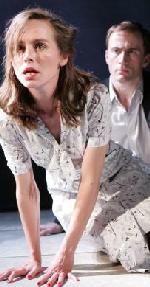
Tara Fitzgerald as Vera Claythorne And Anthony Howell as Captain Lombard
(Photo: Tristram Kenton) |
Murder mystery plays are very well attended and the ones which tour the many regional theatres regularly sell out. There hasn't been a big hit since Daldry's production of J B Priestley's An Inspector Calls in 1995, which although it sounds like a murder mystery, isn't really, although it has elements of suspense.
So can a talented cast and new writing breathe life into an old novel and come up with something original and vibrant?
And Then There Were None takes place in 1938 when ten people have been summoned to an island off the Devon coast by person or persons U N Owen (Geddit?). Two are servants and the other eight are guests. They meet at dinner and each has no idea why they have been invited. There are no boats to let them escape from the island and they are reduced to trying to get messages to the mainland with a heliograph. A jazz record is played which switches to a human voice which accuses every one of contributing to the death or deaths of someone else. At the end of dinner, Anthony Marston (Sam Crane) vomits and drops down dead. (At one of the preview performances, the projectile vomiting was over range and hit the front row of the stalls. I can assure you gentle reader that this problem has been addressed and no such catastrophe affected the audience on the night I saw the play.) There is an interesting range of guests: Vera Claythorne (Tara Fitzgerald) ex-nanny and child killer, Dr Armstrong (Richard Clothier), a detective Albert Blore (David Ross), an bitter older woman and bible fanatic Emily Brent (Gemma Jones), a retired General (Graham Crowden), a Judge (Richard Johnson) and a soldier from the colonies Captain Lombard (Anthony Howell) and the aforementioned, socialite Anthony Marston.
I have to confess that I haven't read any of Agatha Christie's novels since I was in the first year of my teens so I cannot be sure that the thin characterisation is the fault of the stage adaptation. I rapidly found Jane Austen to be more to my taste. I suspect that the crime novels may be slight on personality and detailed description. In the first act, what Kevin Elyot has given us is a wonderfully witty pastiche of a mannered dinner party of the period. I liked it very much and found it very funny with great timing from the cast and director. Because the title gives away that we are going to lose nine or maybe ten of these people, the only mystery is what order they will go in and who will be left? The later acts lose the element of pastiche as the characters get more nervous about their fate and the treatment is more conventional. This gives the feeling that writer and director were not sure where to take the play.
The art deco sets are gorgeous. The dining room has a central pillar with the rhyme in silver letters covering it, massive and unmistakable and dominating the room and the stage. The flat roofed white house has balconies with 1930s wide, floor to ceiling, picture railing windows for architectural period feel. I liked too the painted backdrops for scenes on the cliffs and the beach. There is lovely lighting to go with the clear lines of this architecture.
Of the performances, Tara Fitzgerald is excellent as Vera, the woman who has killed for the love of a man. I liked too Anthony Howell's cold hearted killer of Africans but wasn't convinced by the romantic scenes with Vera. I was annoyed by Sam Crane's overblown and frenetic character and my prayers were answered when he was the first to go. The sinister butler (John Ramm) has some of the best lines. The demise of his wife leaves a catering gap which causes one guest to ask, "Is tongue all there is?"
And Then There Were None isn't a deeply satisfying or important evening but there is enough to amuse and divert and I was pleasantly surprised. Agatha Christie's ending has a twist which wild horses will not drag out of me.
|
AND THEN THERE WERE NONE
Written by Kevin Elyot from Agatha Christie's original novel Directed by Steven Pimlott Starring: Tara Fitzgerald, Richard Johnson, Gemma Jones, Anthony Howell With: John Ramm, Sam Crane, Graham Crowden, David Ross, Richard Clothier, Katy Brittain Design: Mark Thompson Lighting: Hugh Vanstone Sound: Gregory Clarke Composer: Jason Carr Running time: Two hours with one interval Box Office: 0870 890 1105 Booking until 26th February 2006 Reviewed by Lizzie Loveridge based on 26th October performance at the Gielgud Theatre, Shaftesbury Avenue London W1 (Tube: Piccadilly Circus) |