SEARCH
REVIEWS
FEATURES
NEWS
Etcetera and
Short Term Listings
LISTINGS
Broadway
Off-Broadway
NYC Restaurants
BOOKS and CDs
OTHER PLACES
Berkshires
London
California
DC
Philadelphia
Elsewhere
QUOTES
On TKTS
PLAYWRIGHTS' ALBUMS
LETTERS TO EDITOR
FILM
LINKS
MISCELLANEOUS
Free Updates
Masthead
Writing for Us
A CurtainUp  London Review
London ReviewThe Andersen Project
|
I knew that this would end like a Hans Christian Andersen story, where humans who have longings and desires die, and animals have lots of children and live happily ever after
---- Frederic |
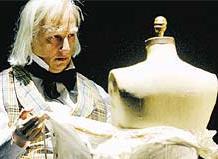
Robert Lepage as Hans Christian Andersen
(Photo: Erick Labbé) |
The Andersen Project is the spine of the play, referring to an idea to transform a Hans Christian Andersen story into an opera for children. The play follows Frederic, the Canadian lyricist chosen to write the libretto, the executive director in charge of coordinating the project for the Opéra Garnier, and a young immigrant called Rashid. Frederic has to navigate the metropolis of Paris as well as his artistic commission, while the opera manager struggles with a marriage on the point of breakdown. Rashid, on the other hand, spends most of his time mopping the pornographic booths where he works.
It is fitting that this play, which is so much about the isolation and loneliness of these figures, is a one-man show. Even Hans Christian Andersen's unrequited love for Jenny Lind is played out onstage as part of a biographical exhibit in a museum. Andersen undresses the numerous layers of nineteenth century female dress from the hoop skirt to the corset, just for the mannequin symbolising Jenny to flee at the last moment.
Lepage assumes these diverse yet intimately connected parts with impossible speed. For one role change, Frederic steps behind a tree and emerges in Victorian female dress and wig a second later. There is also knowing humour in using a single, universal player. The opera manager congratulates himself on choosing a project which dispenses with the need for a chorus, who are expensive "troublemakers." He continually refers to Frederic as the "Tall Albino" and describes the actress chosen to star in the opera as "quite ugly actually".
Being a one-man show, which would seem to limit the production, in fact allows Lepage's resourceful inventiveness to flourish. For example, when one character tells Andersen's story The Shadow to his daughter, he uses the bedside lamp to manipulate his own shadow and then turn himself into a silhouette. This scene assumes an awful poignancy as he himself follows the story's pattern, allowing his darker side to dominate and so destroy him.
Not all the contrivances are this simple, but they are equally effective. Sophisticated technology abounds but, far from ever seeming gimmicky, it is always well-integrated and elegant. Near the beginning, Rashid seems to be spraying graffiti, but what emerges from his aerosol is a sepia-toned photograph of Hans Christian Andersen. In one scene, a marble staircase is projected and echoing footsteps sound as the character walks with an eerie illusion of reality. Again, the Paris Metro is recreated in the background while characters stand on blocks which slide them away as if on a train.
Within this modernistic approach, there is a palimpsest of Hans Christian Andersen's work. His fairy-tales become paradigms for the characters. The subject of the proposed opera, The Dryad, is the story of a wood nymph's ambition to be released from her tree and experience the joys of Paris during the Great Exhibition in 1867. She exchanges her immortality for one day of Parisian life. Similarly for Frederic, the city seemed to promise so much, but fails them and their desires become self-destructive. Throughout the layers of stories there is an affecting awareness that the end of the Romantic era was the beginning of the modern age but also the ended imagination, fantasy and dreams.
This play is utterly beguiling, funny, and moving. Its elegiac, mesmerising beauty is breath-taking. The production is both intricate and wholly unaffected. In the midst of ingenious technological tricks, there is a purity which seems like simplicity about the very human characters at the heart of this drama.
|
THE ANDERSEN PROJECT
Written and directed by Robert Lepage Starring: Robert Lepage Script Collaborators: Peder Bjurman, Marie Gignac Associate Set Designer: Jean Le Bourdais Associate Lighting Designer: Nicolas Marois Sound Designer: Jean-Sébastien Côté Costume Designer: Catherine Higgins An Ex Machina Production Running time: Two hours 5 minutes with no interval Box Office: 0845 120 7554 Booking to 18th February 2006 Reviewed by Charlotte Loveridge based on 27th January 2006 performance at the Barbican Theatre, Silk Street London EC1 (Tube: Barbican) |