
SEARCH
REVIEWS
FEATURES
NEWS
Etcetera and
Short Term Listings
LISTINGS
Broadway
Off-Broadway
BOOKS and CDs
OTHER PLACES
Berkshires
London
LA/San Diego
Philadelphia
Elsewhere
QUOTES
On TKTS
LETTERS TO EDITOR
FILM
LINKS
MISCELLANEOUS
Free Updates
Masthead
Writing for us
A CurtainUp Review
Two Gentlemen of Verona, the Musical
By Eric Beckson
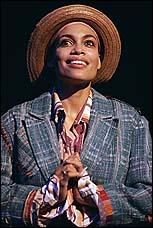
Rosario Dawson as Julia in Two Gentlemen of Verona
(Photo: Michal Daniel ) |
Due to The Public's goal of accessibility, you need not read the play beforehand. However, you may wish to study a Berlitz Self-Teacher if you hope to understand the rapid fire Spanish occasionally discharged by the glamorous peasant, Julia (Rosario Dawson). Forget Verona and Milan; think San Juan and Manhattan.
With abundant songs (39 including reprises), dialogue (and even plot) are relatively unimportant. What is important in this multi-racial, multi-ethnic smorgasbord are the music, lyrics, choreography, and costumes.
Galt Macdermot's music achieves the goal of diversity, planting every kind of beat (from soul to samba) in Two Gents (as it became affectionately known in the '70's). John Guare's lyrics are often funny, sometimes politically pointed, but usually plain or sentimental.
The most reprised song contains the line "You can't love another without loving yourself." That may be true, but as a premise, it doesn't seem like the essence of the story. More pertinent to the plot as well as commentary on both the Vietnam and Iraq wars are these lines from the song "Land of Betrayal", brilliantly sung by Lucetta (Megan Lawrence), servant to Julia: "The air that we breathe is polluted/The wars that we fight are the same/But no one is quite sure who leads us/So no one is ever to blame." Another obvious political statement that could apply as much to Vietnam as Iraq is found in the Duke of Milan's (Mel Johnson, Jr.) song, "Bring the Boys Back Home": If we didn't have a war/Then where/Would we spend our money/Where/Welfare, clean air, child care." One lyric clearly added to that song for our present day debacle: "What's that sign that says I lied/Don't you know God's on my side?"
Besides "Land of Betrayal" the most memorable song is the Motown inspired "Night Letter", sung by Silvia (Renee Elise Goldsberry), the daughter of the Duke of Milan who is pursued by four men. Goldsberry's marvelous voice, flawless movement, and charismatic charm leaves no doubt as to why she's the one most sought after on stage.
In addition to the lyrics, the costumes are a constant reminder of the musical's '70s parentage. Perhaps best described as hippie sheik, they feature bell bottoms, bolero vests, and big Elizabethan sleeves. The dizzying mix and match of color and patterns indicate that costume designer Martin Pakledinaz has done a good deal of his research in lower Manhattan thrift stores. The lead, Proteus (Oscar Isaac), who pursues Julia and then Silvia, wears tight trousers, ruffled shirts, and bolero style vests to maintain the Latin theme. Valentine (Norm Lewis), Proteus's friend and also in love with Silvia, has more of an open shirt Saturday Night Fever look. The '70s theme also extends to the stage itself on which scenic design er Riccardo Hernandez has constructed two large heart shaped platforms, one pink and the other blue.
The choreography by Kathleen Marshall (who also directs) adds terrific joie de vivre. With just the right balance, the chorus never overwhelms the leads or appears superfluous. In a very inventive device early in the show, Proteus sends a love letter to Julia via a chorus acting as a human relay chain. The letter as well as the passion is transferred from one hand off to the next.
Comedic charm flashes throughout -- for example, after Silvia attaches a note to a dove to be sent to her lover Eglamour (Paolo Mantalban), the mechanical dove takes flight, wings flapping, along a wire stretched over the audience. Later, when Eglamour appears in his shredded combat fatigues (the Duke has sent him to war to keep him from Silvia), the dove remains perched on his shoulder as he marches slowly down an aisle toward Silvia (on stage), all the while singing his intense mantra-like love ballad. As the Duke's guards try to prevent him from reaching Silvia, Eglamour raises a single hand, magically disabling the guards, one by one, as if he were channeling the fearsome power of love. It gets even sillier when Eglamour appears with a band of black robed ninjas to fight Valentine and Proteus.
Not so funny or silly is the unimaginative rendering of the wealthy Thurio (Don Stephenson), who is betrothed to Silvia. He is portrayed as the dumpy bespectacled white guy who can't sing or dance. Maybe this played better in 1971 but with the lower half seats of the Delacorte Theater now filled almost entirely with white people (presumably many are corporate sponsors and individuals paying for tickets), the stereotype achieves an unintended irony as well as a reminder of racism's double standards.
The very low point would include any scene featuring Rosario Dawson (of the films Sin City and the forthcoming adaptation of Rent). In a prime example of stunt casting, Dawson possesses the feminine charms to capture our attention (subliminal text: pushup bra), but the bloom fades as quickly as she opens her mouth, especially when she tries to sing (no, mamacita, no). This is a very public stage on which to have a theatrical debut. But movie star celebrities aren’t known for their humility, and it must have been impossible to pass on the opportunity to cast a strikingly beautiful celebrity with black, white, and Hispanic ancestry.
The male leads are quite talented. Norm Lewis possesses the sturdy baritone that serves the Ray Charles inspired ballads. His commanding stage presence creates a calculated chemistry between him and Goldsberry. Oscar Isaac possesses a comic flair although the deceitfulness of his character is never believable.
What's most odd and unexpected is the faithfulness to Shakespeare's plot. In an incredible moment near the end, Valentine offers Silvia to Proteus (who has just a moment earlier nearly raped Silvia). One would expect that in a freewheeling adaptation such as this, Shakespeare’s false priority of friendship over love would be excised, unless the creators of Two Gents confused true love with the free love of their times.
|
TWO GENTLEMEN OF VERONA, THE MUSICAL Adapted by John Guare & Mel Shapiro Lyrics by John Guare Music by Galt MacDermot Directed and Choreographed by Kathleen Marshall Based on the play by William Shakespeare Cast: Tracee Beazer, Bridget Berger, John Cariani, Kate Chapman, David Costabile, Rosario Dawson, Christine Digiallonardo, Shakiem Evans, Ruben Flores, Renée Elise Goldsberry, Danielle Lee Greaves, Oscar Isaac, Joanne Javien, Mel Johnson Jr., Megan Lawrence, Raymond J. Lee, Norm Lewis, Paolo Montalban, Dequina Moore, Maurice Murphy, Richard Ruiz, Stacey Sargeant, Don Stephenson, Amber Stone, Will Swenson, JD Webster and Noah Weisberg. Set Design: Riccardo Hernández, Costume Design: Martin Pakledinaz Lighting Design: Peter Kaczorowski Sound Design: Acme Sound Partners Musical Director and Conducto (Keyboard player: Kimberly Grigsby Band: Woodwinds,Allen Won; Trumpet, Christian Jaudes, Elaine Burt; Trombone, Wayne Goodman: Guitar & Mandolin, Steve Bargonetti; Bass, Wilbur Bascomb; Drums, Brian Brake; Percussion, Joseph Cardello Music Coordinator: Seymour Red Press Running time: and 25 minutes with intermission. The Delacorte Theater, Entrance to Central Park is at 79th Street and Fifth Ave. From 8/16/05 to 9/11/05; opening 8/28/05 Tues through Sun at 8pm Tickets are FREE and will be available on the day of the performance (two per person) at the Delacorte Theater in Central Park beginning at 1:00 p.m. and at The Public Theater, 425 Lafayette Street (near Astor Place), from 1:00 p.m. to 3:00 p.m. Reviewed by Eric Beckson based on 8/26/05 performance |
|
Musical Numbers
| |
Act One
|
Act Two
|
Easy-on-the budget super gift for yourself and your musical loving friends. Tons of gorgeous pictures.




>6, 500 Comparative Phrases including 800 Shakespearean Metaphors by our editor.
Click image to buy.
Go here for details and larger image.