
SITE GUIDE
SEARCH
REVIEWS
REVIEW ARCHIVES
<Broadway
Off-Broadway
Berkshires
London
California
New Jersey
DC
Philadelphia
QUOTES
TKTS
PLAYWRIGHTS' ALBUMS
Masthead
A CurtainUp Review
Curse of the Starving Class
|
Why not borrow if you know it's comin' in? — Weston
|
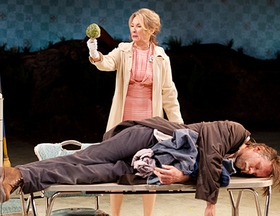
Lori Holt and Bruce McKenzie
(Photo credit: Wilma Theater)
|
Curse of the Starving Class is the first play in Shepard's family trilogy, which continues with Buried Child and culminates in the magnificent True West. Sins of fathers visited on sons is made manifest in Curse as the son dons his father's skuzzy discarded clothes. The family runs out of luck they never had, and their dearest hopes for escape are doomed before the play even begins.
In some star-crossed trajectory under the big Western sky, Curse of the Starving Class intersects with Lonely Are the Brave (Dir. David Miller, 1962) where lone cowboy Kirk Douglas and his horse meet up with a truck carrying toilets for a housing development.
Time-fuzzy illogic paired with tragedy and grotesque humor present quite a challenge for a director. Richard Hamburger, who directs this Wilma production, says in the program that he loves "the way it diffuses tragedy with vivid imagery. . . no matter how far out it appears to be, it has a pulsating heart at its core. " Keeping the heart of it in his sights, he has turned out a superlative production. The cast dazzles, anchored by brilliant Bruce McKenzie as the bummed out father, Weston, who has hocked his family's future.
David Mamet is credited with saying, "If there's an actor on stage with a cat, who are you going to watch, the actor or the cat? You're going to watch the cat…" This goes double for farm animals. An adorable sacrificial lamb is a tough co-star. But Nate Miller and Keira Keeley as the son and daughter, and Lori Holt as the wife deal handily, as do excellent local actors in supporting roles.
The floor under their feet is literally askew. It tilts to stage right, keeping already unstable characters off kilter. Matt Saunders's kitchen set stretches out across the Wilma's overly broad stage, reflecting the play's union of realistic, mythic, and absurd. Kitchen sink realism buts up against symbolism: The stove works and water runs from the sink's faucet. The refrigerator, however, not just an appliance, but a totemic object, provides a beam of light and stealthily connotes the family's howling needs-- and their need is not for food. Upstage, on an expanse of desert terrain, a billboard advertises real estate.
As in the other plays in the trilogy, this wacked-out family clings to improbable hope. The past and the land weigh heavily. The dream is over, but the dreamers are still there, and the dreamers are crazy. Shepard's American West-besotted plays accrue mythological resonance. Many theaters tackle them, but it's not so easy to pull off. The Wilma Theater, with its first production of a Sam Shepard play, has come up with something special.
|
Curse of the Starving Class
by Sam Shepard Directed by Richard Hamburger Cast: David Blatt, Keith Conallen, Sam Henderson, Lori Holt, Keira Keeley, Bruce McKenzie, Nate Miller Peter Schmitz, Ed Swidey Set Design Matt Saunders Costume Design: Kaye Voyce Lighting Design: Steven Strawbridge Sound Design: Christopher Colucci March 07- April 08, 2012, Opening 03/14/12 2 hours, 15 minutes including one 15 min intermission Reviewed by Kathryn Osenlund based on 03/22 performance. Wilma Theater, South Broad Street, Philadelphia |
|
REVIEW FEEDBACK Highlight one of the responses below and click "copy" or"CTRL+C"
Paste the highlighted text into the subject line (CTRL+ V): Feel free to add detailed comments in the body of the email. . .also the names and emails of any friends to whom you'd like us to forward a copy of this review. Visit Curtainup's Blog Annex For a feed to reviews and features as they are posted add http://curtainupnewlinks.blogspot.com to your reader Curtainup at Facebook . . . Curtainup at Twitter Subscribe to our FREE email updates: E-mail: esommer@curtainup.comesommer@curtainup.com put SUBSCRIBE CURTAINUP EMAIL UPDATE in the subject line and your full name and email address in the body of the message. If you can spare a minute, tell us how you came to CurtainUp and from what part of the country. |

Slings & Arrows- view 1st episode free
 Anything Goes Cast Recording
Our review of the show
 Book of Mormon -CD
Our review of the show