
SITE GUIDE
SEARCH
REVIEWS
REVIEW ARCHIVES
ADVERTISING AT CURTAINUP
FEATURES
NEWS
Etcetera and
Short Term Listings
LISTINGS
Broadway
Off-Broadway
NYC Restaurants
BOOKS and CDs
OTHER PLACES
Berkshires
London
California
New Jersey
Philadelphia
Elsewhere
QUOTES
TKTS
PLAYWRIGHTS' ALBUMS
LETTERS TO EDITOR
FILM
LINKS
MISCELLANEOUS
Free Updates
Masthead
A CurtainUp Los Angeles Review
The Scottsboro Boys
By Jon Magaril
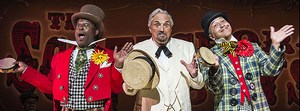
Trent Armand Kendall, Hal Linden and JC Montgomery
(Photo by Craig Schwartz) |
In 1931, two white women, about to be charged with prostitution, claimed they'd been raped by nine young black men on a freight train. At trial, the Scottsboro Boys were found guilty. Progressive groups, most notably the American Communist Party, championed their cause. One of the women recanted her testimony, but all-white juries continued to find them guilty at trial after trial for another decade.
The story doesn't exactly scream "Broadway musical!" But once again, Kander, Ebb, and their librettist David Thompson find the perfect genre to wrap the tale in rousing yet irony-rich entertainment. In a perfect example of meta-theatrics, they use the minstrel show, that infamously racist form of entertainment, to depict a legendary example of racial injustice.
The opening "Minstrel March" presents the basics of the form. The company jubilantly parades through the house. They're joined on stage by three stock figures. Mr. Bones (JC Montgomery) and Mr. Tambo (Trent Armand Kendall), "men of many faces" and a ton of terrible jokes, flank the Interlocutor (Hal Linden, in a welcome return to the theater), "the master" of his ensemble, the Scottsboro Boys. Tonight he's presenting their story.
One of them, Haywood Patterson (Joshua Henry, in his Tony nominated performance) asks, This time can we tell it like it really happened?" That would be a first, as Mr. Bones and Mr. Tambo have never told the truth before. The number establishes lines of potential conflict between between the African-American boys" and the white leader as well as between truth and convention. But the show mystifyingly lets those lines go slack until the finale.
What's more, the terrific conceit is developed in a fuzzy fashion. The opening number keeps repeating, "Everyone's a minstrel tonight." But there's little sense of what being a minstrel means. The genre went through different phases, with all-white, all-black and mixed race ensembles. Common to all was a white-washing of history, with happy slaves and beneficent plantation owners.
True to form, Bones and Tambo lampoon most of their roles. But, against the norm, they send up only the white characters. If this turnabout were performed by the "boys," a great subversive energy would be unleashed. But Bones and Tambo are part of the troupe's power structure and there's no sense that what they're doing is any different from the usual.
Worse still, an additional conceptual layer adds to the murk. The show is told from the perspective of a silent, middle-aged black woman as she waits for a bus. When she finally takes focus in the coda, she provides a happy ending of sorts, in showing how their mistreatment inspired epochal changes for the better. But her presence further denies the subjects agency in their own story.
Nonetheless that story still makes the blood run cold, while the tuneful numbers get the senses humming. The performances, led by Henry's sterling example as Patterson, are stirring. And the staging, economical and unstintingly inventive. Director-choreographer Susan Stroman works wonders with yet another conceit, a set consisting mostly of just chairs and planks.
Two numbers in particular bring all the elements together to blazingly theatrical effect. In "Electric Chair, Bones and Tambo explain to the terrified youngest prisoner, Eugene Williams (Deandre Sevon), the details of the death sentence the Interlocutor has just handed down: "Oh, the juice runs through you/ And you start to shake/ It's a kind of tap dance." As the lights strobe, they put him through the unsettling and exhilarating routine.
"Financial Advice" is Mr Bones' attempt, as the prosecuting Attorney General, to sway the jury that the alleged victim Ruby Bates (Gilbert L. Bailey II) has recanted only because the defendants' lawyer from up north has paid her off: "When there ain't no cash.../ And you wish you was dead/ There's one solution honey/ Go get some Jew money.”br>
The jaw-dropping, no-holds-barred approach of these numbers turns politically incorrect minstrelsy on its head. They may offend those who prefer to see things only in black and white. After all, the Broadway run was picketed by protesters who felt any use of the genre and, in particular, blackface should be forbidden. Similarly, at the performance I attended off-Broadway, an audience member felt the Financial Advice" number was anti-semitic.
The creative team assumes we know prejudice is bad. The Scottsboro Boys takes the more interesting, and dangerous, step of directly tapping us into third-rail currents that ran openly through our culture not so long ago. With each move to ever larger houses, the production has lost some juice. But Kander and Ebb's boldest show, with its ingenious staging and uniformly strong cast, does justice to the songwriters' legacy and the subject matter.
To read the review of the New York off and on Broadway productions with a complete song list, go here
|
The Scottsboro Boys Music and Lyrics: John Kander & Fred Ebb Book: David Thompson Direction & Choreography: Susan Stroman Cast: Joshua Henry, Hal Linden, Trent Armand Kendall, JC Montgomery, Gilbert L. Bailey II, David Bazemore, Christopher James Culberson, Justin Prescott, Clinton Roane, Cedric Sanders, Deandre Sevon, Christian Dante White, C. Kelly Wright Scenic Design: Beowulf Boritt Lighting Design: Ken Billington Costume Design: Toni-Leslie James Sound Design: Jon Weston Orchestrations: Larry Hochman Musical Arrangements: Glen Kelly Vocal Arrangements: David Loud Music Director: Jesse Kissel Associate Director & Choreographer: Jeff Whiting Running time: One hour and 50 minutes without an intermission Runs: Tuesday through Sundays until June 30, 2013 Ahmanson Theatre 135 N. Grand Ave., Los Angeles. Reservations: (213) 628-2772 Reviewed by: Jon Magaril |
|
REVIEW FEEDBACK Highlight one of the responses below and click "copy" or"CTRL+C"
Paste the highlighted text into the subject line (CTRL+ V): Feel free to add detailed comments in the body of the email. . .also the names and emails of any friends to whom you'd like us to forward a copy of this review. Visit Curtainup's Blog Annex For a feed to reviews and features as they are posted add http://curtainupnewlinks.blogspot.com to your reader Curtainup at Facebook . . . Curtainup at Twitter Subscribe to our FREE email updates: E-mail: esommer@curtainup.comesommer@curtainup.com put SUBSCRIBE CURTAINUP EMAIL UPDATE in the subject line and your full name and email address in the body of the message. If you can spare a minute, tell us how you came to CurtainUp and from what part of the country. |
 Anything Goes Cast Recording
 Book of Mormon -CD